Why a Vulnerability Scan Doesn’t Automatically Make You PCI Compliant
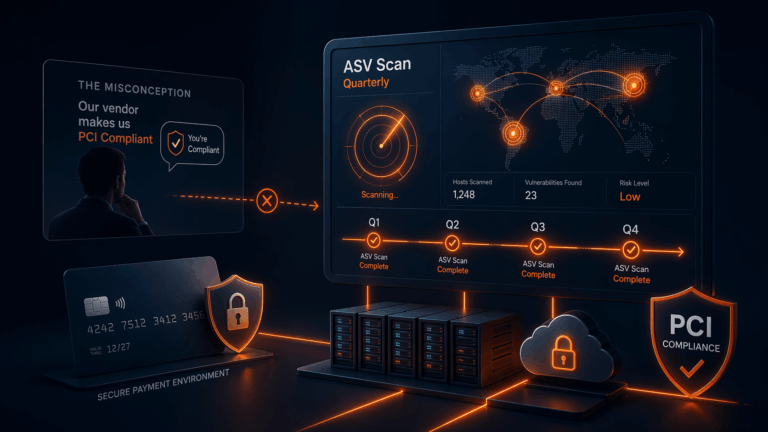
Many merchants assume that if they are running a vulnerability scan, they are covered for PCI. That is a common misunderstanding, and it can create a false sense of compliance. Under PCI DSS, the required external vulnerability scans tied to Requirement 11.3.2 must be performed through an Approved Scanning Vendor (ASV) program, not just any general-purpose scanner or unmanaged scan service. PCI SSC defines an ASV as an organization with an ASV scan solution used to conduct external vulnerability scanning services to validate adherence with PCI DSS Requirement 11.3.2, and says that solution must be tested and approved by PCI SSC before the company is added to the official ASV list.
That distinction matters because a useful scan and a PCI-valid scan are not always the same thing. A general vulnerability scanner may help identify security issues, but that does not automatically mean the scan satisfies the PCI external scanning requirement. PCI SSC’s merchant resource guide was published specifically to help answer scan-related questions, including questions from merchants dealing with the external scan requirement and evidence of passing scans.
Why merchants get confused
This usually happens in a few ways. A merchant buys a general vulnerability scanning tool and assumes the report is enough for PCI. A provider markets “PCI scanning,” but the merchant never confirms whether the underlying service is actually being delivered through an Approved Scanning Vendor. Or a team receives a vulnerability report and mistakes that for the compliance documentation their acquirer, bank, or assessor expects.
In other words, a scan can improve security without automatically satisfying PCI compliance.
What actually counts for PCI
PCI SSC states that an ASV conducts external vulnerability scanning services to validate adherence with the external scanning requirements of PCI DSS Requirement 11.3.2. PCI SSC’s resource guide also says Requirement 11.3.2 requires evidence of passing external scans, performed by an ASV, at least once every three months.
That is a narrower and more specific standard than simply “run a vulnerability scan.” It means the external compliance scan has to come through the approved ASV program model.
A useful scan is not always a PCI ASV scan
This is where merchants often get tripped up. Vulnerability assessment tools are valuable. Clone Systems’ vulnerability assessment materials position those services around identifying and prioritizing weaknesses, while Clone’s PCI compliance scanning service is positioned separately around PCI DSS compliance and reporting.
A simple way to think about it is this:
A general vulnerability scan helps you discover weaknesses.
A PCI ASV scan is a specific compliance scan delivered through a PCI SSC-approved ASV program to satisfy PCI DSS external scanning requirements.
That distinction is exactly why a merchant can be doing “scanning” and still not have the right evidence for PCI validation.
Buying through a partner or reseller
PCI scanning is not always purchased directly from the ASV name a merchant sees on the PCI SSC list. In some cases, scanning may be offered through another provider, platform, or branded service. That does not automatically make it invalid, but it does mean merchants should confirm what sits behind the service.
The important question is not only who sold the scan. The important question is whether the scan is actually being delivered through an Approved Scanning Vendor structure and whether it will produce the PCI reporting expected by the bank, acquirer, or assessor. PCI SSC’s ASV guidance is focused on that underlying requirement, not just the label on the front of the service.
Questions to ask before you assume you are compliant
If a merchant is relying on a tool or third-party provider and assumes they are PCI compliant, these are the right questions to ask:
Is this scan being performed through a PCI SSC Approved Scanning Vendor?
Is the underlying scan solution part of an approved ASV program?
Will I receive the PCI scan documentation and passing report expected for compliance purposes?
If this is sold through a partner or reseller, which ASV is behind it?
Those questions are how a merchant separates a generic security scan from a PCI-valid external scan requirement. PCI SSC also advises clients to check the official ASV list regularly to ensure their ASV has maintained its status.
Is Your Scan Actually PCI-Valid?
Not all vulnerability scans satisfy PCI DSS requirements. Clone Systems delivers external scans through a PCI SSC Approved Scanning Vendor program — so your evidence holds up with your bank, acquirer, or assessor.
Why this matters right now
PCI SSC’s resource guide specifically highlights merchants dealing with external scan obligations, including those completing this requirement for the first time. That means many organizations are entering this process with incomplete assumptions about what “having a scan” actually means.
A team may be doing something useful from a security perspective and still be missing what PCI validation requires from a compliance perspective.
What merchants should take away
The key point is not that general vulnerability scanning lacks value. It is that PCI compliance has a specific requirement for how external scans are performed and documented. Merchants that rely on third-party tools or providers should make sure they understand whether they are getting a general security scan, a PCI ASV scan, or both. PCI SSC’s guidance makes that distinction important.
Final takeaway
A vulnerability scan can absolutely help improve security. But that alone does not mean it satisfies PCI DSS external scan requirements. For PCI compliance, the required external scans must be performed through an Approved Scanning Vendor program, and merchants using third-party tools or providers should confirm that their service is genuinely backed by that structure.
The risk is not that merchants are doing nothing. The risk is that they may be doing something useful, while incorrectly assuming it is also the thing PCI requires.
Is Your Vulnerability Response Fast Enough?
AI is compressing the time between disclosure and exploitation — from weeks to hours. Clone Systems combines vulnerability scanning, penetration testing, and 24/7 SOC monitoring so you can detect, validate, and respond before the window closes.
References
- PCI Security Standards Council. ‘Approved Scanning Vendors.’ Available at https://www.pcisecuritystandards.org/assessors_and_solutions/approved_scanning_vendors/.
- PCI Security Standards Council. ‘Resource Guide: Vulnerability Scans and Approved Scanning Vendors.’ Available at https://blog.pcisecuritystandards.org/resource-guide-vulnerability-scans-and-approved-scanning-vendors.
- Clone Systems. ‘PCI Compliance Scanning & ASV Services.’ Available at https://www.clone-systems.com/pci-asv-scan-external-vulnerability-scanning/.
- Clone Systems. ‘White-Label PCI Compliance for Hosting Providers.’ Available at https://www.clone-systems.com/white-label-pci-asv-scanning-hosting-providers/.
- Clone Systems. ‘Vulnerability Assessment Services.’ Available at https://www.clone-systems.com/network-vulnerability-assessment-services/.
- Clone Systems. ‘Resources.’ Available at https://www.clone-systems.com/cybersecurity-resources-and-pci-guides/.